After 45+ years of ministry, in a variety of different Christian traditions, I’ve come to the deep conviction that every single person needs continuous conversion—especially when it comes to me. The core of this post I first penned twenty years ago, but I believe it now even more, given the rise of spiritual counterfeits, running unchecked on the digital blogosphere, bombarding us, our children, and our grandchildren.
My spiritual background, which was an ever-evolving mixture of Lutheran, Congregationalist, Calvinist, Charismatic, and evangelical tenants, pretty much ignored the need for any kind of continuous conversion. From my first attendance at a summer Bible camp, I became convinced that my surrender to Jesus meant I was “once saved–always saved”, and though Luther may have claimed that he could “commit adultery ten-thousand times a day and still not lose his salvation”, I became seriously convinced, both from my 20-years of pastoral work and my personal experience, that continuous conversion is absolutely necessary and desperately needed.
Upon becoming Catholic, I quickly learned that salvation by grace through faith in Christ has always been understood as a life-long, continuous conversion, a continuous surrender to Christ. And though my family and I have been Catholics for over 30 years, I’m constantly being startled by new aspects of this wonderful Catholic faith, which I thought I had come to understand, but which in reality I understand only as “in a mirror dimly.” This process of continually discovering new aspects of the faith, as well as awakening to debilitating baggage from our past, is what I’d like to consider in this post.
Allow me to illustrate this with a diagram:

The above three circles represent:
CIRCLE A: Our formation before and apart from our Christian formation. This represents all the sources of information—parents, family, friends, teachers, books, media, experiences, etc.—that formed our understanding of God, life, religion, self, etc., before we received specific instruction as a Christian. For those of us baptized as infants, one might say this accounts for very little, but actually, until we’re catechized, the amount of baggage in Circle A can get pretty hefty!
CIRCLE B: The new Christian sources of formation that awakened our desire for a deeper understanding of the Christian faith and/or a conversion to faith in Christ, as well as the ongoing formation of our understanding of the Christian faith. This includes preachers, priests, teachers, catechists, books, media, experiences, family, friends, et cetera.
CIRCLE C: The true fullness of the Christian faith, teaching, and experience, which is not necessarily equivalent to what we received in Circle B. In other words, Circle C represents what is in fact true, whereas the sources in Circle B, as well as Circle A, may include lots of partial truth, combined with prejudice, superstition, even heresy.
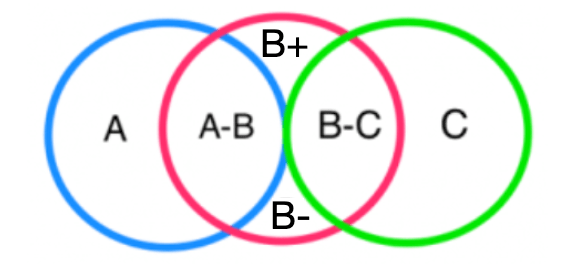
The following combination of these three circles is one way of representing an individual’s present formation in relation to the three sources mentioned, and as I reflect on this, I believe, from my experience, that this model is true of Christians of all traditions, and addresses that which continues to divide us:
In other words, there are at least SIX kinds of knowledge and/or experiences that make up our present state of formation:
SECTION A: The residual “baggage” of our past knowledge and experience, which continues, sometimes subconsciously, on into our present religious life, but still needs examination and correction. It can hold us back from growing in Christ.
SECTION A-B: Those aspects of our past knowledge and experience that did not need to change as a result of our conversion; areas of equivalence. This may represent truths we knew deep in our conscience but now have come to recognize as significant aspects of our Christian faith.
SECTIONS B+ and B-: Things we learned from our Christian sources that were not precisely in line with the fullness of the truth; things we were taught to be true and necessary by, otherwise, sincere believing Christians, but instead were either less than (B-) or more than (B+) accurate expressions of the faith, some of which remain undetected until challenged.
SECTION B-C: Those aspects of Christian truth we learned, which required radical changes from our past. Doctrines, ways of living, ethics, and morals, that we had to relearn or correct.
SECTION C: Those aspects of the Christian truth that we have yet to learn.
In my own journey, for example:
“A” includes lingering presumptions I have about the surety of my salvation, based on my previous longstanding presumption of “once saved—always saved.” This also includes a lingering presumption of the trustworthiness and authority of my own interpretation of Scripture.
“A-B” includes my continuing belief in the Trinity, the divinity of Christ, the infallibility of Scripture, and in Mary as the virgin Mother of God.
“B-” represents ways I was taught, by Catholics, to challenge and question the Authority of the Church, that continue to prevent me from submitting fully to the Teaching authority of the Church. For example, that the Magisterium in union with Peter does not have the authority to change how we celebrate Mass.
“B+” represents, for example, certain devotional practices that I was taught, by well-meaning Catholics, as necessary, but which are in fact over and above what the Church recommends or are even unhealthy for authentic spiritual growth.
“B-C” includes many things I now recognize as true as a Catholic that I didn’t believe in my Protestant past, like the trustworthiness of Sacred Tradition, the authority of the Magisterium in union with Peter, the blessed gift of a purgatorial “mud room” as the vestibule into heaven, and the intercession of the Saints.
“C” includes lots of stuff (!) I’ve yet to learn!
If you reflect on the significance of this diagram, you will see how different it is for each person, sometimes radically different even between life-long members of the same Christian tradition. We each have differing levels of residual baggage from our formative years (A), of less-than-accurate information we’ve picked up along the way from less-than-accurate sources (B- and B+), and, of course, lots of the truth we’ve yet to learn (C).
It is the conflict of these differences that continues to plague the Christian community, because every Christian confronts other Christians with differing combinations of formation, which is one of the reasons that every single one of us (maybe mostly me) needs continuous conversion.
Saint Augustine is credited with saying, “In essentials unity, non-essentials diversity, in all things charity.” It may be that he was merely affirming a long repeated axiom of the Church, but I doubt if he foresaw the extent to which modern Christians have become divided over what are essentials and non-essentials, and the extremes to which we would forget charity.
As I noted in a recent post, Psalms 11:3 addresses this question of “essentials”:
If the foundations are destroyed, what can the righteous do?
The debates continue in Christendom as to what are these “foundations” or “essentials”, are they presently “destroyed”, who are “the righteous” with the authoritative responsibility to decide what these foundations or essentials are, and if they are destroyed, what the “righteous” need to “do”. I believe the confusion over these questions can be attributed to a pervasive lack of continuous conversion.
As I also noted in a previous post, I do not believe the conscientious, continual reading of Scripture alone—as infallible and divine as I believe it to be—is a trustworthy, reliable guide for continuous conversion. One does not have to look far in our world—and especially into the digital social world—to see the infinite number of diverging and contradictory paths this has led so many thousands of well-meaning, searching souls. I also found, from experience, that a deeper and deeper search into history or into philosophy, or an open-minded listening to all the voices across the internet, are not sure foundations for a continuous conversion in Christ.
What I’ve found, again from experience, is the great gift the Catechism of the Catholic Church is as an essential first step to identifying (1) residual baggage (A) that holds us back, as well as (2) inaccurate information (B- and B+) that needs to be purged from our hearts and minds, so that (3) our knowledge and practice can grow more and more in union with Christ and His Church (C). But I’m not saying that all we need is “continuous catechetical instruction,” because what is needed is not merely a matter of continuous education, but of spiritual change, a change that is primarily the work of God’s grace, not of ourselves; a growth in holiness.
What this requires is a continuous recognition of the inadequacies, holes, and blind-spots in our own spiritual formation, and a humble willingness to continuously examine our understanding and practice of the faith. As Jesus himself instructed in his Sermon on the Mount, we need the “attitudes of the Beatitudes”: poverty of spirit, mourning for our sins, meekness, a hungering and thirsting for righteousness, a merciful purity of heart, etc., all of which lead us to grow more deeply in our union with Christ and His Church.
Our Lord once made a disturbing revelation to his followers:
Not everyone who says to Me, ‘Lord, Lord,’ shall enter the kingdom of heaven, but he who does the will of My Father in heaven. Many will say to Me in that day, ‘Lord, Lord, have we not prophesied in Your name, cast out demons in Your name, and done many wonders in Your name?’ And then I will declare to them, ‘I never knew you; depart from Me, you who practice lawlessness! (Mt 7:21-23)
How can our Omniscient Lord Jesus not know us? Do we not believe that He knows each of us better than we know ourselves? And don’t most sincere Christians do all they can to “know, love, and serve” Him? So, how is it that He might fail to know us?
Remember those five maidens who did not have enough oil for their lamps? Why did the bridegroom refuse to let them into the marriage feast? Because He said, “I do not know you” (Mt 25:12).
In our journeys of faith, are we continuously preparing ourselves to meet Him? And when we do, will He know us?
In light of the diagram, I believe one way we can become better known by Him, is through continuous, prayerful self-examination—ideally under a spiritual director—identifying residual baggage (A) as well as inaccurate information (B+ and B-) so that we can grow deeper in the truth of Christ and His Church (C). This also involves reexamining that which we have come to believe is true (A-B and B-C) to make sure we haven’t grown lax in presuming that, because of it, we are somehow guaranteed of one day entering into the great Wedding Feast of the Lamb.
This is essentially what Saint Paul instructed the Christians at Corinth:
Since we have these promises, beloved, let us cleanse ourselves from every defilement of body and spirit, and make holiness perfect in the fear of God (2 Cor 7:1).
Or as the author of the Letter to the Hebrews warns:
Strive for peace with all men, and for the holiness without which no one will see the Lord (Hebrews 12:14).

 Just an old man out standing in his field
Leave a comment