We’ve all seen The Wizard of Oz, which is pretty much all about Dorothy doing everything possible to get back home to Kansas. But when the fake wizard floats away in the out-of-control balloon and she believes she has lost all hope, what is she told? The Good Witch tells her that she has had the means of getting home all along, in those two ruby red slippers. I know this is probably a dumb analogy–and it’s probably been used in this way myriad of times before–but it reminds me of how most of us think about our baptisms.
In Saint Peter’s First Letter, which many scholars believe may have been a baptismal homily, he reminds his Christian audience of what they had received as a result of their faith in Christ, sealed through baptism:
But you are a chosen race, a royal priesthood, a holy nation, God’s own people, that you may declare the wonderful deeds of him who called you out of darkness into his marvelous light. Once you were no people but now you are God’s people; once you had not received mercy but now you have received mercy. (1 Pet 2:9,10)
Peter was writing to first generation Christians who had become dispersed from Jerusalem, “aliens and exiles” (2:11) in the seedbed of expanding Christianity in the lands surrounding the Mediterranean Sea. Most of his audience were adult converts who had received baptism later in life upon entrance into the Church. Consequently, Peter reminds them that, before their faith in Christ and consequent baptism, they “were no people” in need of salvation, or extrication, from their pagan, lost culture and lifestyles.
Later in that first letter, Saint Peter honed in on the importance of baptism:
Baptism, which corresponds to this [Noah and eight others being rescued from the flood through the Ark], now saves you, not as a removal of dirt from the body but as an appeal to God for a clear conscience, through the resurrection of Jesus Christ, (1 Pet 3:21)
Earlier in this same letter, Saint Peter had stressed that it was through baptism that they were “born anew to a living hope” (1 Pet 1:3), “not of perishable seed but of imperishable, through the living and abiding word of God” (1 Pet 1:23; cf. Jn 3:3-5).
Sant Paul, in what many scholars believe was his own baptismal homily, made a similar declaration to the Ephesian Christians:
And you he made alive, when you were dead through the trespasses and sins in which you once walked, following the course of this world, following the prince of the power of the air, the spirit that is now at work in the sons of disobedience.
Among these we all once lived in the passions of our flesh, following the desires of body and mind, and so we were by nature children of wrath, like the rest of mankind.
But God, who is rich in mercy, out of the great love with which he loved us, even when we were dead through our trespasses, made us alive together with Christ (by grace you have been saved), and raised us up with him, and made us sit with him in the heavenly places in Christ Jesus, that in the coming ages he might show the immeasurable riches of his grace in kindness toward us in Christ Jesus.
For by grace you have been saved through faith; and this is not your own doing, it is the gift of God — not because of works, lest any man should boast. (Eph 2:1-9)
The Ephesian Christians, as well as those to whom Saint Peter wrote, were not extracted and saved out of their dead, pagan lives because of any improved behavior or good deeds they might have done while still living as pagans, but rather, while they were still “dead through [their] trespasses”—“while…yet sinners” (Rom 5:9)—Jesus Christ, through His grace, touched their hearts, minds, and consciences, and brought them home to the Church.
As to the importance of baptism, Saint Paul wrote to the Christians in Rome:
Do you not know that all of us who have been baptized into Christ Jesus were baptized into his death? We were buried therefore with him by baptism into death, so that as Christ was raised from the dead by the glory of the Father, we too might walk in newness of life. For if we have been united with him in a death like his, we shall certainly be united with him in a resurrection like his. (Rom 6:3-5)
To the Christians at Colossi Saint Paul wrote:
In him also you were circumcised with a circumcision made without hands, by putting off the body of flesh in the circumcision of Christ; and you were buried with him in baptism, in which you were also raised with him through faith in the working of God, who raised him from the dead. (Col 2:11-12)
Through faith and baptism, these first Christians were saved (cf. Mk 16:16) and became children of God, “a holy nation, God’s own people” (cf. Jn 1:12; 1 Jn 3:1), empowered as “a royal priesthood” to worship God the Father through His Son Jesus Christ by the power of the Holy Spirit, and to witness—to “declare the wonderful deeds of him who called you out of darkness into his marvelous light.”
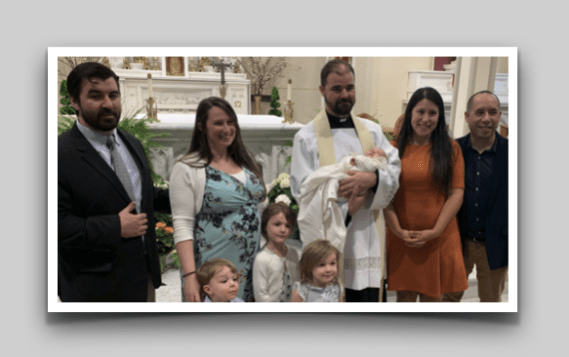
We sometimes forget what our childhood baptisms did for us, or at least too often take this for granted. But anyone who by grace through faith has been sealed with baptism, is therefore “in Christ”, has received the same undeserved graces and blessings as those first century Christians addressed above by Saints Peter and Paul. We, too, were once “no people” but are now “God’s people” by grace through faith, and born anew through baptism, received even as ignorant infants in the hands of our faithful parents and a minister of God. As Saint Paul wrote in that early baptismal homily:
In Him you also, who have heard the word of truth, the gospel of your salvation, and have believed in him, were sealed with the promised Holy Spirit, which is the guarantee of our inheritance until we acquire possession of it, to the praise of his glory. (Eph 1:13,14)
Through our baptisms, we were “sealed with the promised Holy Spirit”, and empowered by grace to worship and witness. Not just “worship,” which is what the majority of Christians — Catholic or non — throughout the world think is the sum total of our responsibilities as members of the Church or our “ecclesial communities”; but also, to “witness”–to tell others in our life about what Christ has done for us so that by grace they too can become “in Christ” through faith and baptism.
But baptism is no guarantee of Heaven, for how we worship and witness must be demonstrated in how we love. Dorothy Day once made the following reflection: “I really only love God as much as I love the person I love the least.” Certainly in this she was reflecting upon Christ’s great parable of the Sheep and the Goats — “As you did it to one of the least of these my brethren, you did it to me” (Mt 25:40) — as well as St. John’s exhortation:
But if any one has the world’s goods and sees his brother in need, yet closes his heart against him, how does God’s love abide in him? … If any one says, “I love God,” and hates his brother, he is a liar; for he who does not love his brother whom he has seen, cannot love God whom he has not seen. (1 Jn 3:17; 4:20)
As we together progress through the reflections of Lent, aiming toward a time when we gather together in Church sanctuaries on Easter Eve, before priests holding aloft the Body and Blood of our Lord, as new members are received, some even being baptized for the first time, let us remember what our baptism calls us to do: to worship Him with every aspect of our being, and to share with others what we, by God’s grace and mercy, have received from Him. We are to help one another discover the fulness of God’s love and mercy, in Christ Jesus, and in His Body, the Church, so that we can “have unity of spirit, sympathy, love of the brethren, a tender heart and a humble mind” (1 Pet 3:8).
Are you concerned about whether one day you will be welcomed into our promised heavenly home? If we were baptized and have faith in Christ, then we already have what we need “to get home”, as long as we live this out in worship, in witness, and in love.

 Just an old man out standing in his field
Leave a comment