

The fence line in the above photo has a Michenerian history, and as “just an old man out standing in my field”, my entire homesteading experience definitely has the same Michenerian bent.
You may be wondering what the heck is a “Michenerian” bent?
Before I explain, I want to thank those of you who have encouraged me to return to blogging. I fell behind and then gave up, because I just couldn’t imagine myself telling anyone how to do anything on their homestead! Even the most wayward FFA kid knows more about farming in his little finger than I’ll ever learn in my life-time; even my last lonely chicken glared askance at me, scowling, “This was all your fault!”
There is also such a myriad of good, faithful, inspiring spiritual writers on the Net, I increasingly doubted that I had anything unique and life-changing to say anymore–“Time for younger, sharper pens to shoulder the task of fighting the good fight!” But I do miss writing, but mostly I miss your feedback and camaraderie in these difficult times! Yes, there are hundreds of spiritual and homestead writers out there, but only a handfull (in my crotchety, “old man out standing in his field” opinion) seem to have a clue what we’re really facing as we approach the 2000th anniversary of our Savior’s passion on the cross. So I’ll try to post a thought from time to time: if you’re so moved, please pass along your thoughts; if you’re not, the Internet overflows with alternatives.
A “Michenerian” bent refers to the style of a renown 20th century author, James A. Michener. Wikipedia describes him as having written “long, fictional family sagas covering the lives of many generations, set in particular geographic locales and incorporating detailed history”, such as Hawaii, Alaska, Chesapeake, Texas, Space, and, my favorite, The Source.

I would suggest that an important part of homesteading is discovering the Michenerian history of the spot that you and your family have decided to call home–the spot where God in His wisdom has, at least for the moment, placed you .
The fence line in the photo has a long history. Around 200 years ago, the first European pioneer to live on this hilly property settled his family in, cleared by hand enough of the dense virgin forest to build a cabin, and then eventually cleared more so he could raise sheep–his aging father was the first weaver in this part of backwoods Ohio. At some indeterminable date, he erected the first perimeter fence along this boundary, probably from hand-split rails, or a long line of overturned massive virgin stumps.
Then sometime in the late 19th century, the split-rail/stump fences were replaced with either woven wire or barbed wire, or a combination of both.
When my wife inherited the first ten acres of our now forty acres, the fence lines had all become sieves due to disuse and inattention. They couldn’t hold anything in or keep anything out. So “my three sons” and I, and some expensive contractors, spent months repairing, rebuilding, and adding new modern secure perimeter fences, either woven with a hot-wire along the bottom, or six-strand high-tensile electric wire. For nearly twenty-years, this new and improved perimeter fence kept suffolk sheep, longhorn, angus, and hereford cattle, an old quarter horse named Skippy, and several Jersey milk cows safely in, as well as varmints like coyotes and dogs out.
Eventually, as I approached “retirement”, I figured that one of the good reasons for doing so was to return to “farming” while I was still basically in good health, before I found myself sporting a hernia by just looking at a shovel. Over the years, though, I’d become too busy and too often away, traveling or at the Office, and then our three sons each moved on with their lives. Consequently, by the time I turned seventy-one, and was ready to once again replace repetitive, diesel guzzling brush-hogging with livestock to eat the lush pastures, the perimeter fences were all in dire need of repair, replacement, or overgrown with multiflora rose briars and spice bushes.
In some ways, I had become so negligent, that the fields had reverted almost back to square one–I could no more let a critter safely loose on this land than that first settler 200+ years ago. And now if the repairs needed to be done, it seemed like my only option was to pay someone big bucks to correct all the mistakes that had accumulated due to my own negligence.
But then I remembered why I had “retired”–to have more time while I still had decent health–and then a grand-child reminded me of that age-old question: “How do you eat an elephant?”
So, through the final weeks of summer and the cool weather of fall, I began attacking that disheveled, overgrown perimeter with a pair of long lopers, a chain saw, a battery-powered extension treesaw, and a good pair of leather gloves. My next project is to replace a half-dozen rotted posts.
In the opening photo, you can now look west uphill along the south perimeter of Westfield, with both sides now cleared so that I can keep it clear with my tractor and brush mower. As you look up along this line, you’re seeing about 200+ years of hands-on heavy labor and care; actually some of the fence posts are over 50 years old, hewn from locally grown Osage Orange trees, and erected by my wife’s grand and great-grand fathers.
It was when I was replacing a rotten post, pulling out the old fence staples, digging a replacement hole with a hand-auger, inserting and securing the new post, and re-attaching the six-wires, that the Michenerian aspect of this homestead hit me. What I was doing was in partnership with the many who had stood in this very spot before me, and all of us in our own ways had contributed to the ups and downs of this farm.

I also thought of the Michenerian journey of my own 71 years of life, the ups and downs, the people, the places, and the thought that for most of my life, I would never have dreamed that my wife and I would have the privilege to spend our twilight years out here on this beautiful farm, rebuilding a fence line, to the sound of a dozen birds squawking, “What the heck is that old guy doing?”
One could easily write a book comparing the repairing of fallen fence lines to our personal spiritual lives and our need for continual renewal. But as I took a needed break, sitting, sipping some fancy electrolyte cocktail, and meditating on the panorama of the 50+ year old post with the 100+ year old barn in the background, I remembered the “Five W’s and one H” from elementary school English. This seemed like a simple way to ask, “What are You trying to tell me, Lord, in the repairing of this fence line?” Again, this could evolve into six books, but I’ll force myself to be succinct!
WHO? Well, unless I paid big bucks to an outside professional, the only person left to do this is me. And besides, if an outsider does this, who has no personal connection to this farm and its “Michenerian” history, there will be a huge gap in the underlying motivation for getting it done. It will just be a job to earn a paycheck. And again besides, I won’t really have any ‘skin in the game’ except for what I dig out of my wallet. I’m the one called to do this; no one else.
The same is true of our spiritual lives. We can’t pay an outsider to straighten up the fences in our spiritual lives; and the best of ministers, priests, and spiritual guides can at best only give advice or convey blessings. In the end, we will stand individually before God for what we have done in this life (cf. Rev. 20:12), so it’s up to us, by grace, to mend our own spiritual fences.
WHY? I realize “Why?” traditionally comes later in the list, but in this case, it’s important to consider first. Why, at this decrepit time in my life, is it essential that I turn off the television, get out here, and mend this overgrown, rotting, rusted old fence? The countryside around me for miles is strewn with old, abandoned fence lines. Why is it so important for me to make all this effort to tear down and then rebuild this 200+ year old fence line? It can’t just be because “it’s here” and “has a history” or that “I have an obligation to carry on the tradition and keep it repaired for all future generations!” As I’m sure farmers may have said before on this very land, “Bull pucky!” The only reason I can see a need to fix this fence right now is because sometime in the future either I or someone after me will want to once again let livestock graze on these pastures. As it stands now, any sheep let loose on this land will indeed be let loose. They will not be contained and no varmints will be kept out. The only way for these fields to be able to fulfill their purpose for raising, feeding, or protecting livestock is if I take responsibility and repair these fences. Now, if I discern that these fields have a different purpose–say, to let them revert back to wilderness as a pollinator abattoir–then that may be a different story. Then I might need to tear down and remove all the residual fences, but once I do this, I pretty much eliminate anyone in the future deciding to return this land to what it has been used for throughout its Michenerian past. For now, I’ll just mend the fences, so that I can keep my options open–maybe next year I just might get motivated to add a few sheep; if I don’t mend the fences, this will no longer be an option.
As for our spiritual lives, this pretty much just tags onto what I said before. Sometime in the future, near or far, we’ll have to give an account for what we have done with the gift of this life. Oh, I know there are an increasing number of people that pooh-pooh this; who think God and Jesus and sin and our responsibility before God are all just a myth, just an attempt by crusty old f+rts like me to stifle their freedom and woke-creativity. I’ll not argue the point here, but just leave them to face what happens when someday they’re asked to put spiritual sheep on their unkept spiritual fields. You see it isn’t just about facing some kind of presumed judgement sometime in the far distant future; it’s about facing the spiritual trials of this life now, in the midst of all the craziness we see and hear happening all around us. God the Father is just patiently waiting for us prodigal children to come home so he can help us, forgive us, heal us, love us (and if you don’t think you’re a “prodigal son or daughter”, just read 1 John 1:5-10). We need to mend our spiritual fences now so that we can safely, by grace, abide in Christ (John 15:1-17). Fortunately, we’re not left to do this alone. Just as I couldn’t repair my fences without the right tools, God has provided countless tools to help us mend our spiritual fences, but this requires that we release our grasp on the myriad of false gods that pollute our lives, and turn back to Him.
WHAT? As far as my fence lines, this involved far more cogitation than you might imagine. What kinds of fence (woven, high-tensile wire, barbed wire, even wood planks and posts, etc.), what kinds of posts (store-bought treated wood, home-seasoned black locust, fiberglas, steel T-posts, etc.), how to attach the two (staple, plastic, porcelain, etc.), and whether or not electric (solar or land-line). And of course this all involved choosing between hand and mechanical tools, such as between a hand-auger or a PTO driven 3-point post hole digger. There were lots of options to accomplish this one seemingly simple task.
When it comes to what needs to be done to mend our spiritual fences, this could easily fill libraries of books–and I know from my 45+ years in ministry that whatever I suggest, I will receive some words of endorsement, but mostly yards of words correcting, countering, or just clattering away about what I missed or imperfectly expressed. So I’ll just humbly keep it as simple and practical as possible: What do we need to do right now?
All of Christian history–all of salvation history–can be boiled down to the simplicity of what has been called “The Two Ways”. There is the Righteous Way of following God’s will, or the other way, the Wicked Way of turning away and following some other voice (most often our own). One of the earliest Christian books, the Didache, called these two paths “the Way of Life” and “the Way of Death”. It’s essentially what the apostle John referred to in the opening of his gospel: the way of light and the way of darkness.
In a moment I’ll describe HOW we are to do this, but for now, I just want to say that this is a blueprint against which we are to examine our spiritual fence: is its trajectory, as well as its present condition, aligned with God’s will, the Righteous Way of Light and Life, or headed in a different direction, the Wicked Way of Darkness and Death?
“But how can I know?” Tell you in a moment.
WHERE? Someone might answer, “Well, DUH, ah pazume yer fixin’ dem posts whar dey is? Yah fix’em whar dey be broke?” True, true. But that particular 500 yard section is just a small portion of the mile long array of fences that surround and criss-cross our forty acres. So, yes, it comes down to priority, or as Stephen Covey once wrote in his Four Quadrant approach to time management: You begin with the “urgent–important” but never forget the “non-urgent–important”, which in fact over time proves to be the most important. The “urgent–important”? Yes, that overgrown, rotting, rusted sieve of a fence line right in front of me needs immediate attention, if it’s to be of any use in the future. But also, the entire mile-long array of fences needs a thorough examination to find staples that need hammering in or replacement, wires that need tightening, trees that have fallen onto the fence and need removal, and of course the constant string trimming to prevent small growth from becoming overhanging briars and bushes.
The same is true of our spiritual fences: there are “urgent–important” areas that need immediate attention, as well as “non-urgent–important” areas that must not be ignored or else we’ll face problems in the future, leading to potentially insurmountable spiritual atrophy. Fr. Garrigoo-Lagange once wrote, “In the ways of God, he who does not progress, looses ground.” Contrary to what many Christians believe, no one is “once saved–always saved”. Abiding in Christ requires daily and long-term attention, as we willfully respond to grace.
An “urgent–important” task? Apologizing to someone we’ve hurt? Mending a broken relationship? Admitting to God our sinfulness, and pleading for His forgiveness and mercy? Returning to someone something we borrowed far too long ago? Fulfilling a promise we once made to someone? Maybe even going back to church and the sacraments after months, years of absence? Maybe just stopping right this moment to thank God for all of His undeserved blessings!
“Non-urgent–important” tasks? Maybe set aside a time for daily personal prayer and Bible reading. The benefit of this over the long haul is immeasurable! What can you do now to ensure that your family, your grandchildren, etc., will have the environment, resources, and encouragement to continue progressing in their spiritual lives, regardless of how crazy the world around them devolves? These things may not seem “urgent” now, but you want to address them before they become too urgent to fix!
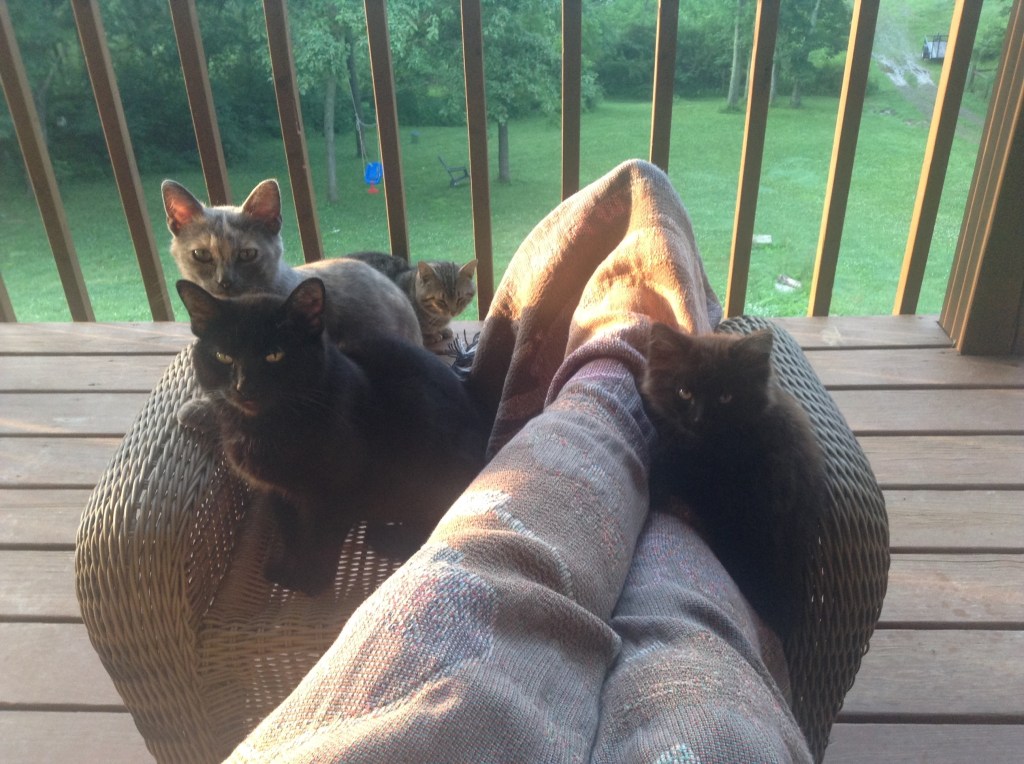
WHEN? I think I covered this a bit in the previous section: the “urgent–important” repairs right now, and attention to the “non-urgent–important” as a regular maintenance, the same being true for our spiritual fences. But I do need to admit that there have been far too many times that I’ve sat relaxing on my porch, with beverage of choice in hand, looking out over my fields, thinking long and hard about all those “urgent–important” repairs, as well as “non-urgent–important” improvements that need to be made if I ever want to use those fields again. But instead of getting out there to do it, I just kept on relaxing, sipping that beverage of choice, maybe digressing off into the myriad of “urgent and non-urgent–unimportant” thoughts that too often fill my life. When do the repairs need to be made? Right now, or at least as soon as is reasonably possible–otherwise, we all know, they’ll likely never get done. And next year when my grandkids ask when I’m going to get those sheep or ponies I’ve always talked about, I’ll have to come up once again with some lie to cover up my procrastination.
The same is true of our spiritual fences, of course. “Lord, when did we see thee hungry or thirsty or a stranger or naked or sick or in prison, and did not minister to thee?” In the earliest day of the Church, the author of Hebrews felt the need to write:
“Let us hold fast the confession of our hope without wavering, for he who promised is faithful; and let us consider how to stir up one another to love and good works, not neglecting to meet together, as is the habit of some, but encouraging one another, and all the more as you see the Day drawing near” (Heb. 10:23-25).
Already, Christians were no longer holding fast. They needed stirring up! They were skipping Church maybe to play some primitive form of golf! But like them, too many of us just keep sitting, spiritually, procrastinating, sipping our spiritually unproductive beverages of choice.
HOW? Spiritually, there are of course libraries of books of advice, instructions, and methods on how to grow in the spiritual life. Unfortunately, many of these methods worked great for the authors but really didn’t work as well for anyone else. So I’ll just focus on what I promised earlier: how to make sure one is walking the Righteous Way of light and life, and not the Wicked Way of darkness and death.
Maybe the most surprising thing is how simply practical the Scriptures describe this: it basically involves what we do with our bodies. From Genesis through Revelation our relationship with God is described by what we do with our eyes, ears, lips, hands, knees, feet, (private parts), mind, and heart. What are we looking at? Listening to? Doing with our hands? Kneeling to? Doing with a “private parts”? Following with our feet? And as we do these things with our bodies, what are we thinking about or meaning by our actions? What are our intentions? Are we looking at, listening to, saying, doing things on the outside, in the sight of others, that are different than the reasons we are thinking in our mind? And all of this, our actions and our thoughts, affect our heart, our inner being. As David once said to his son, Solomon, “the Lord searches all hearts, and understands every plan and thought. If you seek him, he will be found by you; but if you forsake him, he will cast you off for ever” (1 Chron. 28:9).
Our Lord himself once warned:
“The good man out of his good treasure brings forth good, and the evil man out of his evil treasure brings forth evil. I tell you, on the day of judgment men will render account for every careless word they utter; for by your words you will be justified, and by your words you will be condemned” (Mt. 12:35-37).
Who, what, where, when, why, and how we live out our faith with our eyes, ears, lips, hands, knees, (private parts), feet, minds, and hearts is how we mend and maintain the spiritual fences of our lives.
I suspect I’ve been a bit too long-winded, maybe a bit too much like Michener himself. So, probably best to just close this post with some final trustworthy advice from Saint Paul (1 Thess. 5:16-18):
Rejoice always,
pray constantly,
give thanks in all circumstances;
for this is the will of God in Christ Jesus for you.


 Just an Old man out standing in his field
Leave a reply to mavongunten Cancel reply